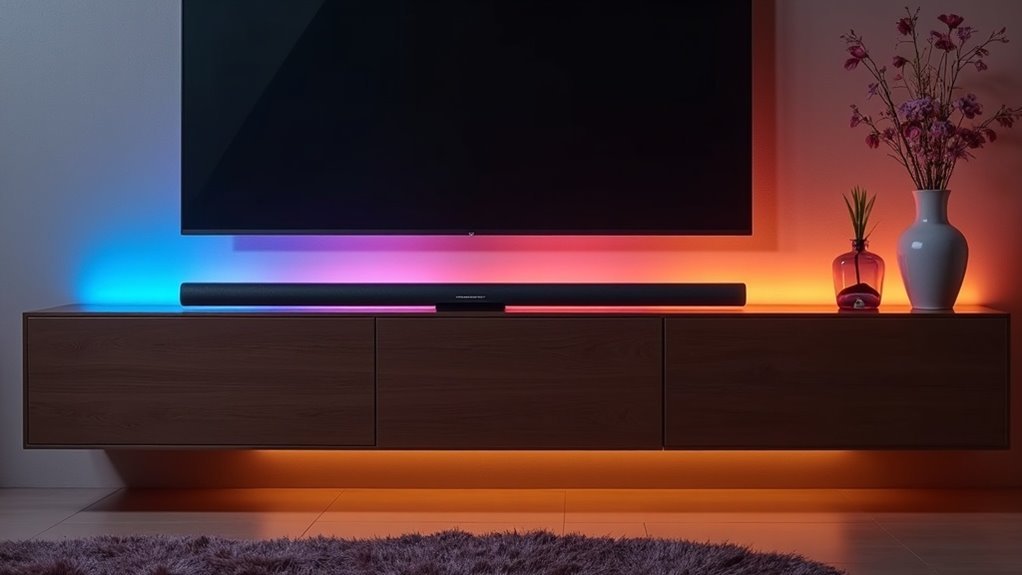
Yes, a soundbar can block an IR receiver, especially if it’s positioned directly in front of your TV. This obstruction can hinder the line-of-sight needed for effective remote control operation. Ideally, position your soundbar ½ to 1 inch below the TV’s IR sensor, with a height of less than 3 inches. This minimizes interference and enhances signal reception. If you’re looking for tips on optimizing your soundbar setup to avoid IR blockage, there are various solutions available to improve your home entertainment experience.
Key Takeaways
- Yes, soundbars can block an IR receiver if they are positioned directly in front of the TV’s IR sensor, obstructing remote control signals.
- To prevent obstruction, it is advisable to place the soundbar ½ to 1 inch below the TV’s IR sensor and ensure it is less than 3 inches tall.
- Adjusting the height of the TV stand to be taller than the soundbar can improve IR signal reception and reduce blockage.
- If the soundbar’s placement obstructs the IR signal, consider using an IR repeater to restore remote functionality.
- Alternatively, Bluetooth remotes or smartphone apps can be used, as they eliminate line-of-sight requirements and reduce interference from obstacles.
Understanding IR Receiver Functionality
An infrared (IR) receiver is a crucial component in soundbars, enabling seamless communication with remote controls for optimal functionality. This sensor detects IR signals, allowing you to operate your soundbar wirelessly.
However, if the soundbar obstructs its own IR receiver, you may experience difficulties with remote control responsiveness. Since IR signals can be blocked by physical barriers, it’s essential to position your soundbar carefully to avoid interference.
Most soundbars don’t come with built-in IR repeaters, meaning they can’t relay commands if they obstruct the IR signals. Ensuring a clear line of sight to the IR receiver is critical for peak performance of your soundbar.
How Soundbars Can Obstruct IR Signals
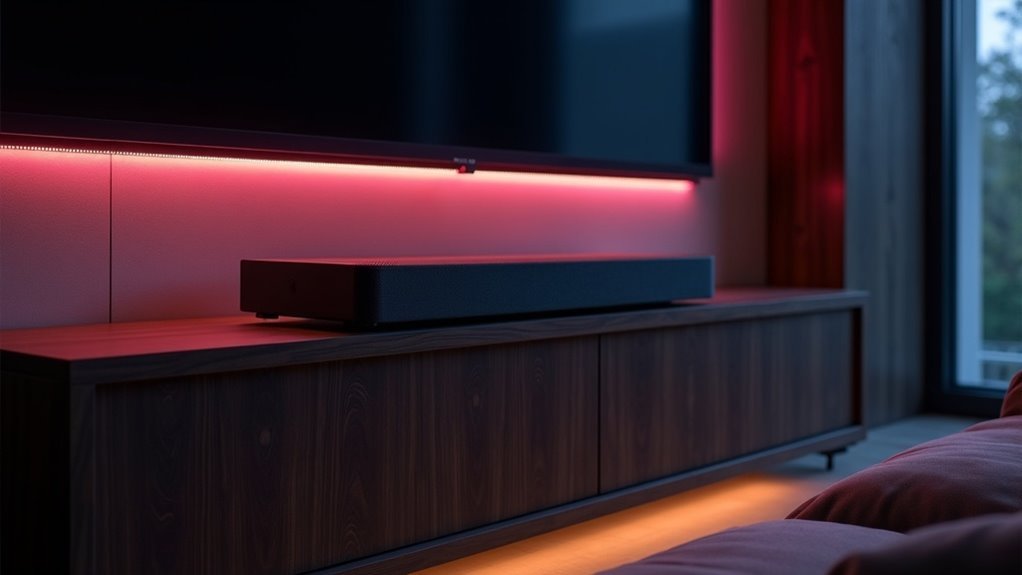
When positioning a soundbar, it’s crucial to consider how it might obstruct the IR signals from your remote control. If the soundbar is placed directly in front of your TV, it can block the IR sensor, disrupting command transmission.
The height of the soundbar is also important; a taller model may obstruct the line of sight to the IR receiver, complicating functionality further. Since infrared signals diffuse like light, any obstruction can degrade signal quality.
While some soundbars come equipped with built-in IR repeaters, they aren’t very common. Adjusting the soundbar’s position can help ensure an unobstructed path to the IR sensor, allowing for seamless control of your audio and visual experience.
Effective Soundbar Placement Strategies
To guarantee maximum remote control functionality for your soundbar, you need to take into account the height at which you place it.
Position the soundbar off-center or at an appropriate distance from the TV’s infrared sensor, typically 1/2 to 1 inch below, for effective signal reception.
After adjusting the placement, always test the remote to confirm that there are no obstructions interfering with the IR signal.
This will ensure optimal performance of your soundbar and enhance your overall viewing experience.
Optimal Height Considerations
How can you guarantee your soundbar placement enhances your home theater experience without blocking the TV’s IR receiver? To achieve this, aim for a height of 1/2 to 1 inch above the IR sensor, typically found at the bottom center of your TV.
Consider these tips for optimal soundbar placement:
- Ensure the soundbar is less than 3 inches tall to prevent obstruction.
- Adjust the TV stand height to be taller than the soundbar.
- Leave a small gap to improve remote control functionality and ensure seamless operation.
Off-Center Placement Benefits
While many may instinctively place their soundbar directly in front of the TV, opting for an off-center position can greatly enhance both audio performance and remote control functionality.
By positioning the soundbar slightly to the side, you improve the line-of-sight for the remote control signals to reach the IR sensor. Users have discovered that even a small gap between the soundbar and the TV significantly boosts remote command effectiveness.
Furthermore, off-center placement enriches your overall viewing experience by creating a wider soundstage and better audio dispersion, ensuring optimal sound quality without hindering essential remote functionalities.
Testing Remote Functionality
Where can you best position your soundbar to guarantee ideal remote functionality? To facilitate seamless operation, follow these guidelines:
- Position the soundbar ½ to 1 inch above the TV’s IR sensor for optimal signal transmission.
- Check your TV manual for the exact IR sensor location, which is typically centered at the bottom.
- Use a solid object or your smartphone camera to identify the IR sensor’s position and test the remote from various angles.
Continuously monitor the remote signal after each adjustment.
This approach helps you balance sound quality with remote accessibility, ensuring your soundbar setup effectively meets your entertainment needs.
Utilizing IR Repeaters for Enhanced Remote Control
If your soundbar obstructs the TV’s IR receiver, using an IR repeater can help restore remote control functionality.
To set it up, position the repeater’s receiver in a location where it can easily pick up signals from your remote, and ensure that the emitter is directed at the TV’s IR sensor.
After installation, testing the setup will confirm that the IR repeater is successfully transmitting commands.
IR Repeater Effectiveness
How can you ensure your soundbar setup operates flawlessly, even when obstacles block the IR signal from your remote control? An effective solution is to use an IR repeater, which captures and retransmits signals to your soundbar’s IR receiver.
Here are some important considerations:
- The BAFX 54-5EXN-SYMF IR repeater is highly rated for overcoming IR signal blockage, making it a great choice for soundbar setups.
- Position an IR receiver in front of the soundbar and an emitter on your audio device to ensure reliable communication.
- It’s crucial to test your setup after installation to achieve optimal performance, as various environmental factors can affect effectiveness.
Placement Considerations for Repeaters
Utilizing an IR repeater effectively for your soundbar hinges on proper placement to guarantee seamless communication between your remote control and the soundbar.
Position the IR repeater to receive signals directly from your remote, ensuring it’s aimed towards the soundbar’s IR sensor. Consider models like the BAFX 54-5EXN-SYMF for reliability.
If your soundbar has a built-in IR repeater, verify its functionality, as not all models include this feature.
After installation, test the setup to confirm that the remote control performs efficiently with your soundbar.
Thoughtful placement and testing enhance your remote experience, making it easier for you and those you serve.
User Experiences With Soundbar and IR Issues
While many users appreciate the enhanced audio experience that soundbars offer, they frequently face frustrating challenges related to infrared (IR) signal interference.
Some common issues include:
- Soundbars obstructing the TV remote signal, especially when positioned directly in front of the sensor on certain TV models like Sony.
- Noticing improved signal reception when a gap is created between the soundbar and the TV.
- It’s generally recommended to position the soundbar at least half an inch above the TV’s IR sensor to avoid these issues.
Alternative Solutions for Remote Control Access
If your soundbar is obstructing the TV’s IR receiver, there are several alternative solutions to ensure seamless remote control access. You can reposition the soundbar for better visibility, utilize an infrared extension cable, or choose soundbars that come with built-in infrared repeaters. Additionally, consider using Bluetooth remotes or smartphone apps, which eliminate the need for a direct line-of-sight. Experimenting with different placements can help enhance both sound quality and remote functionality.
| Solution | Description | Benefits |
|---|---|---|
| Reposition Soundbar | Adjust the soundbar’s placement for IR visibility | Maintains remote access |
| Infrared Extension Cable | Extends IR signals around obstacles | Overcomes physical barriers |
| Built-in Infrared Repeater | Captures and retransmits remote commands | Seamless control experience |
| Bluetooth Remote/App | Employs Bluetooth for commands instead of IR | No line-of-sight required |