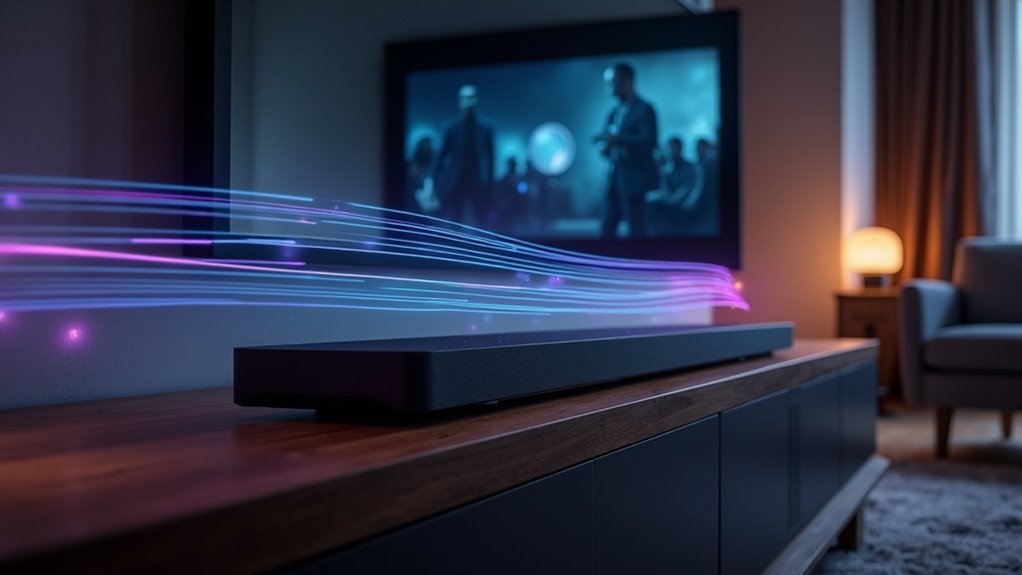
Soundbar spatial audio delivers an immersive, three-dimensional sound environment that enhances audio clarity and depth for your home entertainment setup. Utilizing advanced technologies like Dolby Atmos and object-based audio, soundbars can accurately position sound all around you, creating a fuller soundstage without the need for numerous speakers. Upward-firing drivers reflect sound off surfaces, enhancing height perception and delivering a more dynamic listening experience. This setup ensures clearer dialogue and richer soundscapes compared to standard TV speakers. Continue exploring to discover the technologies and benefits that further elevate your audio experience with soundbars.
Key Takeaways
- Soundbar spatial audio creates an immersive 3D sound environment, significantly enhancing audio quality and sound placement for a richer listening experience.
- By utilizing Dolby Atmos technology and upward-firing drivers, soundbars produce a fuller soundstage, reflecting sound off ceilings and walls to envelop the listener.
- Featuring object-based audio formats, soundbars allow for precise audio placement, enabling sound elements to move dynamically within a 3D space for an engaging experience.
- Compared to traditional TV speakers, soundbars deliver clearer dialogue and more vibrant soundscapes, making them an excellent choice for home theater setups.
- Unlike conventional audio systems, soundbars with spatial audio adapt to the listener’s position, offering a more captivating and realistic sound experience.
Understanding Soundbar Spatial Audio
When you explore soundbars, you’ll discover that models equipped with spatial audio technology fundamentally transform your listening experience by simulating a three-dimensional sound environment.
This advanced feature leverages Dolby Atmos to enhance audio quality, providing precise sound placement that traditional stereo systems can’t achieve. Many soundbars now incorporate upward-firing drivers, allowing sound to bounce off ceilings and walls, creating a fuller soundstage that mimics real-life acoustic environments.
These innovations significantly elevate your audio experience, especially for TVs that lack built-in surround sound capabilities. By utilizing object-based audio formats, soundbars enable sounds to be accurately placed in a 3D space, enhancing realism during movie and music playback.
How Soundbars Create Immersive Audio
Soundbars create immersive audio experiences by utilizing advanced sound processing technologies, with a strong focus on formats like Dolby Atmos. This technology takes advantage of spatial audio formats, allowing sound objects to be placed precisely in a three-dimensional space around the listener.
Many soundbars feature upward-firing drivers that reflect sound off ceilings to enhance height perception, resulting in lifelike audio. Object-based audio technology further enables these devices to reproduce sound movements with accuracy, making audio feel directional.
High-end models, such as the Bose Smart Ultra Soundbar, incorporate multiple speakers and dynamic head tracking, delivering expansive soundstages while maintaining clarity, effectively simulating surround sound without the need for multiple speakers.
Key Technologies Behind Soundbar Spatial Audio
To appreciate soundbar spatial audio, it’s essential to understand the role of object-based audio formats and advanced sound processing techniques specific to soundbars.
These technologies enable sound to be positioned accurately within a three-dimensional space, resulting in an immersive audio experience.
Object-Based Audio Formats
While traditional audio formats often constrain sound to specific channels, object-based audio formats like Dolby Atmos empower users to experience sound as dynamic entities within a three-dimensional space.
These advanced formats treat audio elements as individual objects, allowing precise placement and movement, which significantly enhances the spatial audio experience provided by soundbars.
Soundbars equipped with object-based audio technology deliver clarity and depth by accurately positioning sounds, including those from above.
For instance, models like the Bose Smart Ultra Soundbar utilize proprietary processing to upmix stereo or 5.1 content into spatial audio, achieving an immersive sound experience with fewer speakers.
This innovation makes high-quality audio accessible for home users and integrates seamlessly with smart speakers, elevating your entertainment experience.
Advanced Sound Processing Techniques
As audio technology evolves, advanced sound processing techniques play a crucial role in enhancing soundbar spatial audio. Utilizing object-based audio formats like Dolby Atmos, these techniques enable precise sound placement in a three-dimensional space, which is particularly beneficial for soundbars.
Upward-firing drivers, often integrated into soundbars, reflect sound off ceilings and walls, creating an immersive audio experience with height dimensions. Dynamic head tracking technology, when available, adjusts audio output based on your position, further enhancing realism in soundbar performance.
Proprietary digital signal processing algorithms simulate natural sound propagation, ensuring lifelike interactions with the environment when using a soundbar. Additionally, cross-talk cancellation systems facilitate binaural audio experiences, making 3D sound accessible without headphones in various listening settings, all while maximizing the capabilities of soundbars.
Benefits of Using Soundbars for Spatial Audio
Soundbars designed for spatial audio provide an excellent way to elevate your home entertainment experience.
These innovative systems leverage advanced technologies such as Dolby Atmos and DTS:X to create immersive sound that imitates multiple speakers from just one unit. With upward-firing drivers that bounce sound off the ceiling, they add height and depth to your audio experience.
When compared to built-in TV speakers, soundbars offer clearer dialogue and richer soundscapes, making them a perfect choice for home theater setups. Their space-efficient design means fewer components and less wiring, making them ideal for smaller living spaces.
Additionally, features like adaptive sound technology ensure that audio is optimized for movies, games, and music alike.
Popular Soundbars With Spatial Audio Support
With the increasing demand for immersive audio experiences, several soundbars have emerged as top contenders for spatial audio support.
The LG S95TR enhances your audio experience for TVs, creating an enthralling home theater environment.
The Sonos Arc Ultra utilizes advanced Dolby Atmos technology, delivering a lifelike sound experience with clear dialogue and rich surround sound.
The Sonos Arc Ultra offers an immersive sound experience with crystal-clear dialogue and rich, enveloping surround sound.
The Bose Smart Ultra Soundbar features nine speakers, including upward-firing drivers, for realistic 3D sound.
The Yamaha Sound Projector employs sound beam technology for virtual surround sound, while the Razer Leviathan V2 Pro integrates head-tracking AI and THX Spatial Audio, ensuring ideal audio positioning across compatible devices.
This website is dedicated to exploring the best soundbar options available.
Differences Between Spatial Audio and Traditional Sound
Spatial audio fundamentally transforms how you experience sound through soundbars compared to traditional audio formats.
Here are three key differences:
- Sound Placement: Spatial audio in soundbars utilizes advanced algorithms to position sound objects around you, creating an immersive experience. In contrast, traditional audio typically relies on fixed stereo or surround channels, resulting in a less dynamic sound field.
- Fewer Devices: With spatial audio-enabled soundbars, you can achieve a comparable directional audio experience using just one device, unlike traditional setups that often require multiple speakers for an enhanced surround effect.
- Personalization: Spatial audio technology in soundbars adapts to your position and movements, significantly enhancing your listening experience.
Traditional sound, however, remains static, which can limit emotional connection and realism during playback.
The Role of Dolby Atmos in Soundbar Spatial Audio
Dolby Atmos plays an essential role in enhancing your soundbar’s spatial audio capabilities by delivering an immersive audio experience.
Utilizing object-based sound technology, it allows precise placement and movement of audio within a three-dimensional space, creating depth and clarity that’s crucial for soundbars.
Furthermore, its compatibility with various devices ensures that you can easily access Dolby Atmos content across streaming platforms, maximizing your listening experience through your soundbar setup.
Immersive Audio Experience
To fully appreciate the immersive audio experience offered by modern soundbars, it’s essential to understand how advanced technologies like Dolby Atmos transform sound delivery.
This technology enhances your sound experience by:
- Allowing sound to move freely in a three-dimensional space.
- Utilizing multiple speakers to create a lifelike environment with audio coming from above and around.
- Supporting popular streaming services, ensuring access to content designed for spatial audio.
With upward-firing drivers, Dolby Atmos enables sound to bounce off walls and ceilings, significantly enhancing the immersive spatial audio experience, particularly during dynamic head movements.
This makes soundbars equipped with Dolby Atmos an excellent choice for those seeking a rich and engaging audio experience in their home entertainment setup.
Object-Based Sound Technology
Modern soundbars utilize object-based sound technology to elevate your audio experience beyond traditional surround sound methods.
With Dolby Atmos, sound is transformed into individual objects, allowing for precise sound placement in a three-dimensional space. This technology supports up to 118 audio objects, ensuring an immersive audio experience that envelops you.
Soundbars equipped with upward-firing drivers reflect sound off ceilings, enhancing the lifelike soundscape. Additionally, Dolby Atmos adapts to different configurations, optimizing performance for various setups.
As a standard feature in contemporary soundbars, it significantly enhances audio for home theater systems, making your movies and music more engaging and realistic.
Compatibility With Devices
Achieving an ideal spatial audio experience with your soundbar hinges on its compatibility with Dolby Atmos technology. Here’s what you should consider for optimal device support:
- Ensure your soundbar, such as the LG S95TR or Sonos Arc Ultra, supports Dolby Atmos for immersive audio.
- Check if your preferred streaming platforms, including Apple TV+, Amazon Prime Video, and Netflix, offer content in Dolby Atmos.
- Verify that your television, like the Hisense U6K or TCL QM8, has built-in Dolby Atmos support to enhance the overall audio experience.
Enhancing Your Home Theater Experience With Soundbars
As you look to elevate your home theater experience, soundbars equipped with spatial audio technology present a compelling solution.
These devices, often featuring Dolby Atmos, deliver immersive audio by simulating three-dimensional sound, enhancing your viewing with depth and height.
Models like the LG S95TR improve older TVs’ audio, offering advanced processing and compatibility with Dolby Atmos and DTS:X formats.
Upward-firing drivers create surround sound by bouncing audio off walls and ceilings, eliminating the need for multiple speakers.