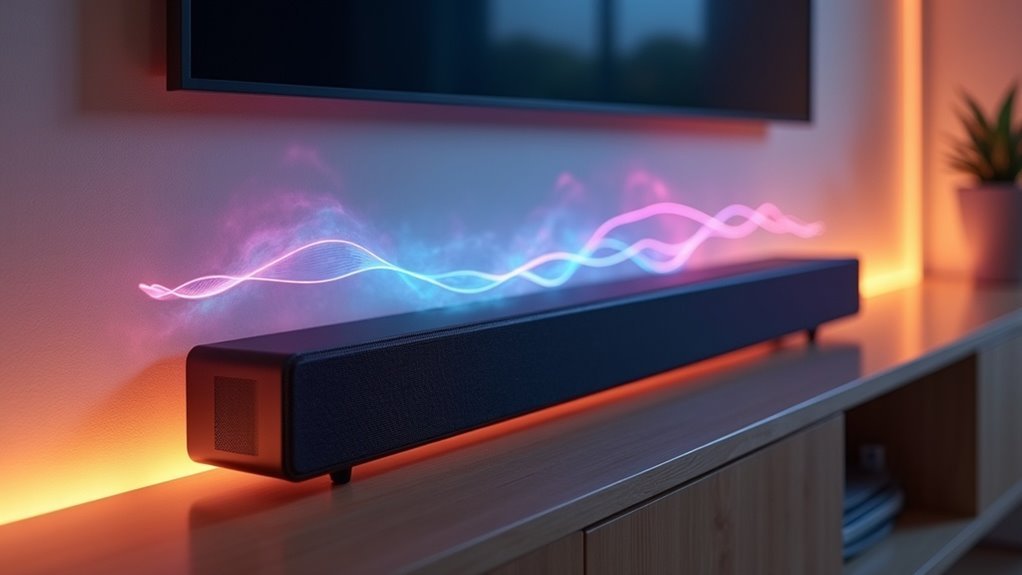
Soundbar binaural rendering is an advanced audio technology designed specifically for soundbars, enhancing your listening experience by simulating a three-dimensional sound environment. Utilizing head-related transfer functions (HRTFs) and sophisticated algorithms, it accurately positions sounds in space, creating a lifelike auditory experience that complements your soundbar setup. This technology adapts audio output based on head positioning, ensuring immersive sound as you enjoy your favorite media through your soundbar. As advancements continue, you’ll discover how this technology is shaping the future of soundbar audio systems.
Key Takeaways
- Soundbar binaural rendering creates an immersive 3D audio landscape, enhancing spatial awareness and elevating the media experience.
- It employs head-related transfer functions (HRTFs) to deliver precise audio localization without the need for multiple speakers.
- Advanced digital signal processing (DSP) enhances standard stereo audio, providing clarity and detail in sound positioning.
- This technology adjusts audio output based on head position, creating a tailored auditory experience that complements visual elements.
- Binaural rendering offers an immersive experience that stands out from traditional surround sound systems, providing convenience and accessibility in a single soundbar unit.
Understanding Binaural Rendering Technology
Binaural rendering technology is a fascinating advancement in audio processing that transforms how you experience sound through soundbars. By simulating a 3D audio landscape, it enhances your spatial awareness and immersion while enjoying your favorite media.
Utilizing head-related transfer functions (HRTFs), binaural rendering adjusts sound characteristics according to the direction of the source, allowing for precise audio localization. Many modern soundbars incorporate this technology, creating a surround sound experience without the need for multiple speakers.
Leveraging advanced digital signal processing (DSP), these soundbars provide immersive audio even from standard stereo sources, especially when combined with specialized headphones or formats like Dolby Atmos for maximum effectiveness.
How Soundbar Binaural Rendering Works
Soundbar binaural rendering operates by employing sophisticated algorithms that create a convincing 3D audio environment, enhancing your home entertainment experience. This process relies on advanced binaural processing techniques, ensuring immersive sound that feels realistic.
Experience immersive 3D audio with soundbar binaural rendering, enhancing your home entertainment with realistic soundscapes.
Key components include:
- Head tracking: Adjusts audio output based on your head position to enhance spatial awareness, making you feel more engaged with the content.
- Head-related transfer functions (HRTFs): Modifies sound signals, making them appear to originate from specific locations in your room, allowing for a more realistic soundstage.
- Upward-firing drivers: Contributes to vertical audio perception, enabling sounds to be experienced as if they’re emanating from above, adding depth to your audio experience.
Together, these elements dynamically adapt to your movements, providing a personalized auditory experience that complements the visual elements of your favorite films and music.
Benefits of Using Binaural Rendering With Soundbars
How does the integration of binaural rendering enhance your audio experience with soundbars? Binaural rendering creates a spatial audio environment that mimics natural sound perception, immersing you in your favorite content.
By utilizing head-related transfer functions (HRTFs), soundbars can adapt audio output based on your position, ensuring an immersive experience that shifts with your movements.
Advanced digital signal processing allows for precise sound positioning in three-dimensional space, significantly improving clarity and detail. This technology effectively upmixes stereo or surround sound, enriching your listening experience without the need for complex setups.
Ultimately, binaural rendering elevates ordinary audio into an extraordinary experience, making soundbars an essential component of your home entertainment system.
Key Features of Binaural Rendering in Soundbars
When you delve into binaural rendering in soundbars, you’ll discover key features that significantly enhance your audio experience.
Immersive audio technology improves spatial awareness, enabling you to perceive sound in three dimensions.
Moreover, compatibility with a wide range of content types ensures that you enjoy optimal sound performance, no matter what you’re watching or listening to.
Immersive Audio Experience
Binaural rendering transforms your audio experience by simulating the way you naturally perceive sound in your environment through soundbars.
This technology enhances your immersion in movies, music, and gaming, creating a more engaging auditory landscape.
Key features include:
- Head-Related Transfer Functions (HRTFs): Adjusts sound based on your position, enhancing spatial sound accuracy for a more realistic listening experience.
- Dynamic Head Tracking: Maintains clarity and sound anchoring, ensuring consistent quality regardless of your movement around the room.
- 3D Audio Upmixing: Converts stereo or surround sound into a lifelike binaural audio experience through your soundbar without the need for multiple speakers.
Together, these elements elevate your immersive audio experience, making it feel truly lifelike, all from the convenience of your soundbar.
Spatial Audio Technology
As sound technology evolves, spatial audio has become a vital feature in modern soundbars, significantly enhancing the listening experience through advanced binaural rendering techniques.
A binaural renderer utilizes sophisticated algorithms and head-related transfer functions (HRTFs) to create a realistic 3D audio environment, customizing sound based on your position. Dynamic head tracking ensures precise sound placement as you move, providing a consistent audio experience.
When paired with Dolby Atmos content, this technology reproduces multiple audio objects in three-dimensional space, delivering depth and clarity.
With an array of drivers, including upward-firing speakers, soundbars effectively create a vertical sound field, enriching your audio playback.
Compatibility With Content
Soundbars equipped with binaural rendering technology excel in their compatibility with a wide range of audio content, significantly enhancing your listening experience.
This compatibility ensures superior sound quality, whether you’re watching movies or enjoying music. Key features include:
- Support for Dolby Atmos content, which delivers rich spatial audio.
- Capability to process various audio formats, including stereo and multi-channel sound.
- Adaptive processing that optimizes binaural rendering based on the type of content, whether it’s films, music, or gaming.
With these advanced features, your soundbar transforms ordinary audio into immersive binaural experiences, enhancing localization and depth in playback for all your entertainment needs.
Comparing Binaural Rendering to Traditional Surround Sound
While traditional surround sound systems rely on multiple speakers to create a directional audio experience, soundbars offer a compelling alternative by delivering an immersive audio experience through a single unit.
Many modern soundbars utilize advanced audio processing technologies to enhance spatial audio, allowing you to perceive sound as it interacts with your environment. Unlike traditional surround setups, which focus on multiple speaker placements, soundbars can simulate height and distance, creating a more encompassing experience.
They’re also more accessible and convenient, perfect for use with televisions, delivering a personal listening experience that contrasts sharply with the broader sound fields typical of conventional surround systems.
Recommended Soundbars for Binaural Audio Experiences
When exploring soundbars that excel in delivering binaural audio experiences, several models stand out for their innovative features and capabilities.
Consider these options for immersive spatial audio:
- Bose Smart Ultra Soundbar – Utilizes advanced digital signal processing and upward-firing drivers for a rich binaural sound.
- Sonos Arc – Supports spatial audio formats and adapts stereo or surround content, enhancing your listening experience.
- LG SN11RG – Features dynamic head tracking, ensuring sound remains anchored to your position, providing an engaging binaural experience.
These soundbars combine technology and adaptability, creating a superior spatial audio environment for music, movies, and gaming.
The Future of Binaural Rendering in Home Audio Systems
As advancements in spatial audio technologies continue to evolve, the future of binaural rendering in soundbars promises to deliver unprecedented immersive listening experiences for home audio systems.
You’ll find soundbars increasingly integrating these capabilities, allowing you to enjoy surround sound effects without the clutter of multiple speakers. Manufacturers are refining algorithms to create realistic 3D soundscapes by utilizing head-related transfer functions (HRTFs), effectively mimicking real-world sound interaction.
With the rise of streaming services supporting spatial audio formats like Dolby Atmos, the demand for these enhanced soundbars will surge. Future innovations may also include adaptive sound technology, optimizing binaural rendering based on room acoustics and your position, ensuring a truly personalized audio experience.