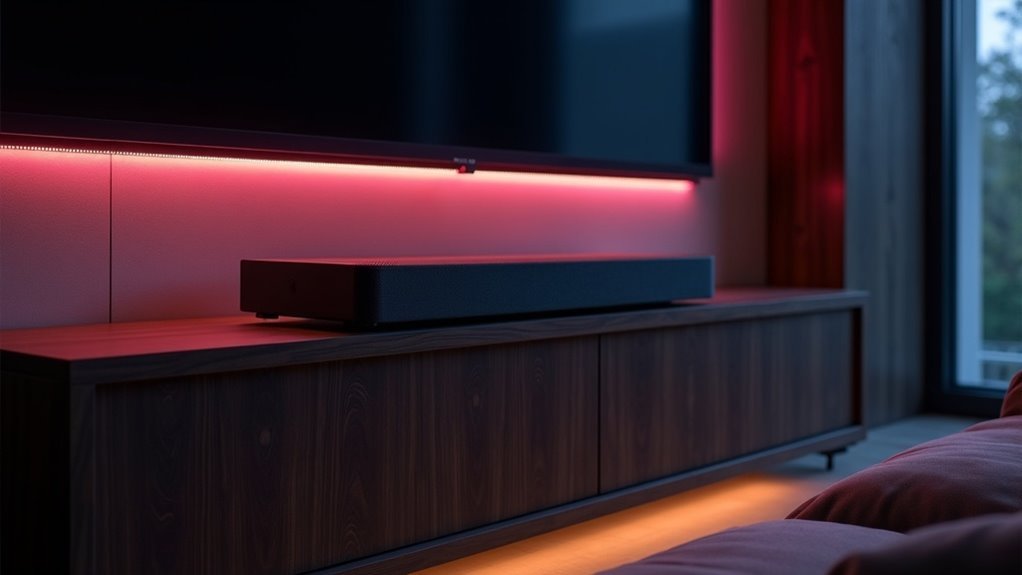
A soundbar’s design can either be ported or sealed, each offering distinct audio characteristics that impact your listening experience. Ported designs feature openings that enhance bass output by allowing airflow, making them suitable for larger spaces. However, they may sometimes produce a boomy sound and require careful tuning to achieve the best results. On the other hand, sealed designs provide a more accurate bass response and minimize distortion, making them ideal for smaller areas. Choosing the right design depends on the size of your room and your personal sound preferences. Explore how these design differences can influence your audio experience with soundbars.
Key Takeaways
- Ported soundbars feature openings designed to enhance bass output, making them particularly suitable for larger spaces where booming sound is desired.
- Sealed soundbars, with their airtight construction, deliver precise bass response while minimizing distortion, resulting in clearer audio.
- While ported designs can often require more space and may experience frequency roll-off and port noise, they necessitate careful tuning for optimal performance.
- On the other hand, sealed soundbars are more compact and ideal for smaller areas, although they typically require more power to effectively produce low frequencies.
- Ultimately, the choice between ported and sealed soundbars hinges on individual sound preferences, the size of the room, and the balance between desired audio clarity and impactful bass.
Understanding Soundbar Designs
When choosing a soundbar, understanding the differences between sealed and ported designs is essential for maximizing your audio experience.
Sealed designs feature airtight construction, delivering tighter and more accurate bass response, which is ideal for music clarity. However, they typically require more amplification to achieve low frequencies and reduce group delay, enhancing sound reproduction.
On the other hand, ported designs utilize openings to enhance airflow, producing louder, boomier bass that’s suitable for larger spaces. While they can reach higher sound pressure levels, they may suffer from port noise and frequency roll-off.
Your choice should reflect the size of your room and your personal sound preferences to ensure the best performance from your soundbar.
Characteristics of Ported Soundbars
Ported soundbars are crafted with one or more openings that promote air movement, significantly boosting low-frequency output and delivering powerful bass performance.
These soundbars are particularly effective in larger spaces, creating a booming sound that’s ideal for home theater setups and high-volume playback.
However, they require precise tuning to avoid timing issues and port noise, which could compromise sound quality.
While ported designs can produce a pronounced frequency peak at the tuning frequency, this may result in a less smooth overall response compared to sealed designs.
Additionally, ported soundbars usually have a larger form factor, necessitating adequate air space for optimal performance and minimal distortion.
Characteristics of Sealed Soundbars
Sealed soundbars deliver precise bass response thanks to their airtight design, which effectively reduces distortion.
Their compact shape makes them ideal for placement in smaller areas, ensuring a controlled acoustic environment that enhances overall sound quality.
However, it’s important to note that they demand more power to produce low frequencies, striking a balance between efficiency and performance.
Accurate Bass Response
Accurate bass response is a defining feature of sealed soundbars, thanks to their airtight construction that effectively minimizes unwanted resonance and phase issues. This design provides superior control over driver movement, leading to diminished distortion and clearer sound reproduction. With a gentler bass roll-off, sealed soundbars ensure consistent sound quality at various volume levels and are often favored for music listening in smaller spaces. They integrate seamlessly with main speakers while enhancing midrange clarity, and the absence of ports means there’s no port noise to disrupt your listening experience.
| Feature | Sealed Soundbars | Benefits |
|---|---|---|
| Construction | Airtight enclosure | Minimizes resonance |
| Bass Response | Accurate and tight | Reduced distortion |
| Noise Control | No port noise | Cleaner audio experience |
This website focuses on soundbars, highlighting their unique attributes and advantages.
Compact Design Benefits
When considering sound quality and space efficiency, the compact design of sealed soundbars offers significant advantages.
Their airtight enclosure guarantees tighter, more accurate bass response, enhancing the clarity of both music and dialogue. This design allows for easy placement in smaller areas without sacrificing sound quality, as sealed soundbars typically require less power for effective low-frequency reproduction.
Additionally, the gentler bass roll-off leads to a smoother frequency response during playback. Without ports, sealed soundbars reduce the risk of port noise, delivering cleaner sound without distortion.
This precision makes sealed soundbars a preferred choice for home theater setups focused on audio detail.
Power Handling Efficiency
The power handling efficiency of sealed soundbars makes them an excellent choice for high-performance audio setups. Their airtight design allows sealed subwoofers to manage increased power without distortion, ensuring a clean bass response.
Unlike ported designs, sealed soundbars typically require more amplification to deliver low frequencies, but this results in superior sound quality characterized by clarity and precision. The minimized group delay produces tighter, more articulate bass tones, allowing sound waves to reach you simultaneously.
Comparing Bass Performance
How do ported and sealed soundbars differ in their bass performance?
Ported soundbars, equipped with a ported subwoofer, enhance bass output by allowing air movement, resulting in louder, impactful bass that’s ideal for larger rooms. However, they can sometimes produce a boomy sound due to rapid bass roll-off.
In contrast, sealed soundbars provide tighter, more accurate bass, making them preferable for music clarity and precision. They feature a gentler roll-off, which helps maintain bass integrity across frequencies.
Timing is also essential; sealed designs tend to align better with main speakers, while ported designs may introduce slight delays.
Ultimately, choose ported for high-output bass or sealed for nuanced sound quality tailored to your audio preferences.
Impact of Room Acoustics
Room acoustics significantly influence the performance of soundbars, especially when considering room size and surface materials.
Hard surfaces can reflect sound waves, resulting in echoes that may distort audio clarity, while the positioning of your soundbar can impact bass response.
Room Size Considerations
When designing a soundbar, it’s crucial to consider the impact of room size on your choice between ported and sealed models.
In larger spaces, ported soundbars excel because they enhance air movement and sound output, although they may produce a boomy effect in smaller rooms.
On the other hand, sealed soundbars are ideal for compact areas as they provide tighter bass without overwhelming the acoustics.
Moreover, the dimensions and layout of the room significantly affect performance; larger rooms may benefit from multiple ported soundbars to ensure even bass distribution, whereas one or two high-quality sealed options are usually sufficient in smaller environments.
Recognizing these factors is essential for achieving optimal sound quality.
Sound Reflection Effects
Understanding sound reflection effects is essential for optimizing your soundbar audio experience. Room acoustics dramatically shape how you perceive sound, with hard surfaces reflecting waves and potentially causing muddiness.
If your soundbar is placed too close to walls, resonances can alter audio clarity. Ported soundbar designs often produce a boomy bass that interacts more with room boundaries, while sealed designs deliver tighter bass response.
This difference influences how frequencies resonate in your space. By strategically positioning your soundbar and considering your room’s layout, you can minimize adverse reflections and enhance overall sound quality, resulting in a more immersive listening experience.
Acoustic Treatment Solutions
To achieve ideal sound quality from your soundbar, addressing room acoustics is essential, especially in environments where reflections and echoes can distort audio clarity.
Factors like wall surfaces and furniture placement significantly influence sound reproduction. Implementing acoustic treatment solutions such as sound-absorbing panels or bass traps can reduce unwanted echoes, enhancing overall clarity.
When using ported subwoofers with your soundbar, be mindful that they might produce pronounced bass, potentially leading to a boomy sound in smaller spaces. Conversely, sealed designs provide tighter bass response, making them more effective in rooms with challenging acoustics.
Evaluating your room’s acoustics is crucial for ensuring a balanced listening experience with your soundbar.
Choosing the Right Soundbar for You
How do you choose the right soundbar for your specific needs?
First, assess your room size. If you’re in a compact space, a sealed soundbar provides tighter, more accurate bass, ideal for audiophiles.
Conversely, if you have a larger room, opt for a ported design, which offers louder, more impactful bass, though it may introduce timing issues.
Consider your sound preferences and the genres you enjoy; sealed models excel in precision, while ported ones deliver a powerful experience.
Ultimately, the choice between sealed and ported soundbars hinges on your unique listening environment and desired audio performance.