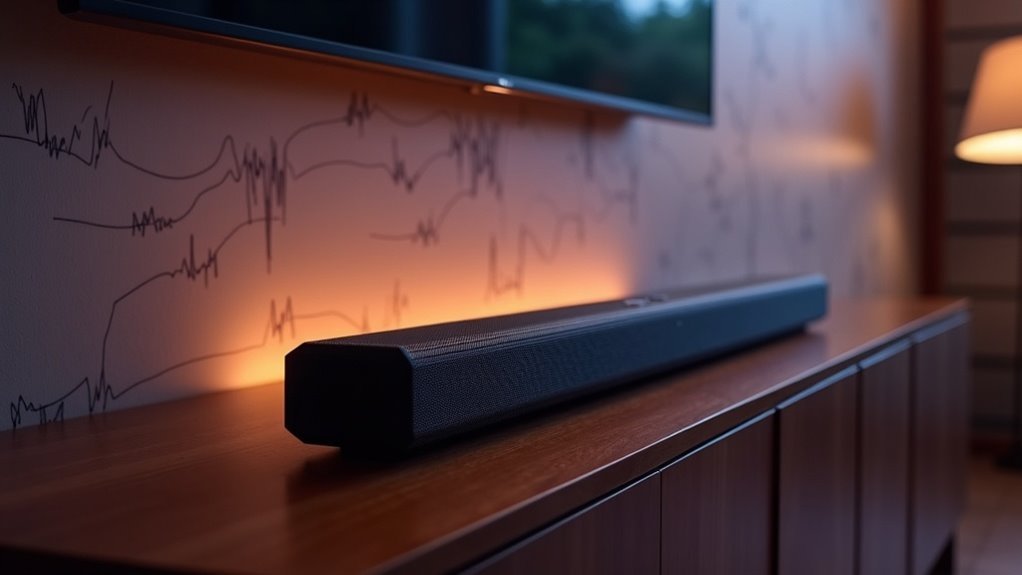
Soundbar psychoacoustic processing employs techniques based on our auditory perception to deliver a more immersive audio experience. By manipulating sound waves with phase shifts and time delays, soundbars can effectively simulate surround sound and improve dialogue clarity. These methods enhance spatial audio perception and mitigate the effects of room acoustics, resulting in clearer overall sound. As technology continues to advance, there are promising developments on the horizon that will further elevate audio quality and performance in soundbars.
Key Takeaways
- Soundbar psychoacoustic processing leverages the principles of human hearing to enhance audio clarity and immersion, utilizing sound perception techniques tailored for an optimal listening experience.
- Dynamic range compression is utilized to improve dialogue clarity, ensuring that spoken words are easily understood even in the presence of background sounds.
- Techniques such as time delay and phase manipulation create spatial audio effects, effectively simulating a surround sound experience that elevates your home entertainment.
- Algorithms dynamically adjust frequency response based on the acoustics of your room, counteracting masking effects for clearer sound reproduction that fits your space.
- Advanced psychoacoustic algorithms and adaptive technologies are integrated to provide a customized audio output, enhancing your overall listening experience with every use of your soundbar.
Understanding Psychoacoustics
Psychoacoustics, the intricate study of how we perceive sound, is particularly relevant when it comes to soundbars and their design. This field explores the complexities of auditory stimuli and how our brains interpret them.
Key indicators such as loudness, pitch, sharpness, and tonality significantly shape your listening experience. Understanding these factors is essential because our hearing typically ranges from 20 Hz to 20 kHz, with peak sensitivity between 1-5 kHz.
This sensitivity is crucial for sound localization and the masking effects that can occur in various audio environments. By applying psychoacoustic principles in soundbar design, manufacturers can create systems that enhance clarity and impact, providing a more immersive listening experience that aligns with human auditory perception.
The Role of Soundbars in Audio Enhancement
The design of soundbars significantly enhances audio experiences by utilizing the principles of psychoacoustics. Through psychoacoustic processing, soundbars are able to create spatial audio effects that simulate surround sound, all while maintaining a compact size.
Techniques such as phase manipulation and time delays allow users to perceive sounds as if they originate from various locations, which enhances overall immersion. Advanced algorithms are employed to adjust frequency response based on your room’s acoustics, ensuring optimal sound quality.
Moreover, psychoacoustic features are implemented to maintain dialogue clarity, effectively reducing the masking effect of background noise and making it easier to follow conversations.
Some soundbars even incorporate subwoofer capabilities, which enrich the low-frequency response and complement the psychoacoustic perception of bass sounds, resulting in a fuller and more satisfying auditory experience.
Techniques in Soundbar Psychoacoustic Processing
While enjoying your favorite movie or music, you may not notice how soundbars utilize advanced techniques to elevate your auditory experience.
These devices employ dynamic range compression to enhance dialogue clarity and maintain detail in quieter scenes, ensuring a balanced audio output. By leveraging psychoacoustic principles, soundbars effectively manage masking effects, optimizing levels for a clearer reproduction of subtle sounds.
Soundbars utilize dynamic range compression and psychoacoustic principles to enhance dialogue clarity and reproduce subtle sounds with precision.
Time delay techniques are also employed to create spatial audio, tricking your brain into perceiving sounds from distinct locations, thereby simulating a three-dimensional sound field.
Furthermore, A-weighting filters adjust the frequency response to align with human hearing sensitivity, while sophisticated algorithms dynamically analyze and adjust speaker output, enhancing loudness perception and reducing distortion for an immersive listening experience.
Sound Localization in Compact Systems
Sound localization in soundbars relies on advanced psychoacoustic principles to create an immersive auditory experience.
By utilizing timing differences and phase shifts between speakers, soundbars generate the illusion of directionality, enhancing your listening experience. The Haas effect is pivotal, enabling sounds arriving within 30 milliseconds to be perceived as a single source.
Psychoacoustic techniques simulate surround sound, enhancing depth and spatial separation without the need for multiple speakers. Additionally, soundbars modify frequency response and leverage equal loudness curves to counteract room acoustics, ensuring sounds appear more localized and natural.
This ultimately improves your overall audio experience with soundbars.
Masking Effects and Audio Clarity
Masking effects significantly influence your perception of audio clarity in soundbars, where it’s essential for dialogue to remain distinct against background noise.
By utilizing psychoacoustic principles, you can improve the intelligibility of spoken words while addressing frequency overlaps that could impede understanding.
Proper speaker placement and dynamic range control are also crucial in enhancing your listening experience, ensuring that key sounds are clearly heard amidst the audio mix.
Sound Localization Techniques
To achieve effective sound localization in soundbars, manufacturers leverage psychoacoustic techniques that utilize both interaural time differences (ITD) and interaural level differences (ILD). These methods enhance your auditory system’s ability to perceive sound directionality. Additionally, soundbars implement algorithms to manage simultaneous masking, guaranteeing dialogue and essential audio cues remain clear. By emphasizing critical mid-range frequencies and applying the Haas effect, soundbars create a spatial audio experience. Here’s a summary of key techniques:
| Technique | Description | Impact on Sound Localization |
|---|---|---|
| ITD | Time differences between ears | Enhances directional perception |
| ILD | Level differences between ears | Improves sound source identification |
| Haas Effect | Timing signals within 30 ms | Creates a sense of depth |
| Frequency Tuning | Emphasizing 1-5 kHz range | Increases clarity of dialogue |
| Masking Mitigation | Algorithms reducing simultaneous masking | Guarantees intelligibility of critical cues |
Discover how these technologies work together in soundbars to provide an immersive audio experience that enhances your home entertainment.
Masking and Perception
While enjoying your favorite movie or music through a soundbar, you mightn’t realize how much louder sounds can obscure quieter ones, ultimately affecting your audio experience.
This phenomenon, known as masking, occurs when a louder sound interferes with your perception of a softer one. For instance, simultaneous masking renders quieter sounds inaudible if they fall within the louder sound’s frequency range.
Backward masking is typically less impactful than forward masking, meaning preceding sounds may fade when a louder sound follows.
Soundbars are designed to combat these masking effects by employing psychoacoustic principles and audio compression techniques, which enhance dialogue clarity and elevate your overall listening satisfaction.
Enhancing Audio Clarity
When sounds compete for your attention, enhancing audio clarity becomes essential for an ideal soundbar experience. Utilizing psychoacoustic principles, soundbars can effectively manage masking effects, ensuring that louder sounds don’t overpower quieter dialogue.
By dynamically balancing sound levels, they maintain clarity during intense scenes while preserving the impact of background audio. Spectral analysis helps identify frequency masking issues, allowing for precise equalization that separates audio elements and further enhances clarity.
Dynamic range compression keeps quieter sounds audible while reducing sudden loud noises. Advanced algorithms simulate three-dimensional soundscapes, tricking your brain into perceiving spatial audio, which enriches the overall listening experience and significantly elevates audio clarity when using a soundbar.
Immersive Audio Experiences With Soundbars
When you utilize a soundbar, you enjoy enhanced spatial audio that simulates a multi-dimensional soundstage.
By leveraging advanced virtual surround sound technology, these devices craft the illusion of audio emanating from various directions, thereby enriching your listening environment.
This psychoacoustic processing not only elevates your audio experience but also fosters a more immersive interaction with your favorite content.
Enhanced Spatial Audio
As soundbars increasingly incorporate psychoacoustic processing techniques, they offer enhanced spatial audio experiences that fully immerse you in a three-dimensional sound environment.
The concept of localization explains how we perceive sound sources in space, and soundbars utilize this principle through the Haas effect. By ensuring sounds reach your ears within 30 milliseconds, they create the illusion of a unified sound source.
Advanced algorithms fine-tune audio output based on room acoustics, while psychoacoustic principles adjust frequency and loudness to simulate depth.
Furthermore, delay and reverb effects replicate natural sound reflections, enriching the lifelike quality of audio and making your listening experience with soundbars profoundly engaging.
Virtual Surround Sound
While traditional audio setups often require multiple speakers to create an immersive sound experience, soundbars now utilize virtual surround sound technology to simulate a three-dimensional audio environment.
This technology employs sound waves, utilizing time delays and phase manipulation to trick your brain into perceiving a wider soundstage.
Here are three key benefits of virtual surround sound in soundbars:
- Enhanced Dialogue Clarity: Voices remain clear amidst complex soundscapes, making it easier to follow the story.
- Immersive Atmosphere: Technologies like DTS Virtual:X and Dolby Atmos position sounds in 3D space, enhancing your viewing experience.
- Room Adaptability: The design and placement of soundbars can significantly enhance the overall audio experience in various room settings.
Future Trends in Soundbar Technology
Future trends in soundbar technology are set to revolutionize how you experience audio through innovative advancements.
Expect to see the integration of advanced psychoacoustic algorithms that enhance spatial audio, allowing for immersive soundscapes that simulate three-dimensional sound localization. This will elevate your listening experience significantly.
Additionally, innovations such as artificial intelligence will facilitate real-time audio adjustments, ensuring enhanced clarity for dialogue and sound effects.
As streaming services increasingly adopt high-definition audio formats, soundbars will support lossless audio codecs, preserving sound quality through psychoacoustic principles.
Wireless connectivity will also see improvements, leading to better synchronization with video playback.
Moreover, adaptive room correction technology will customize audio output to suit your specific environment, ensuring optimal sound performance tailored to your space.