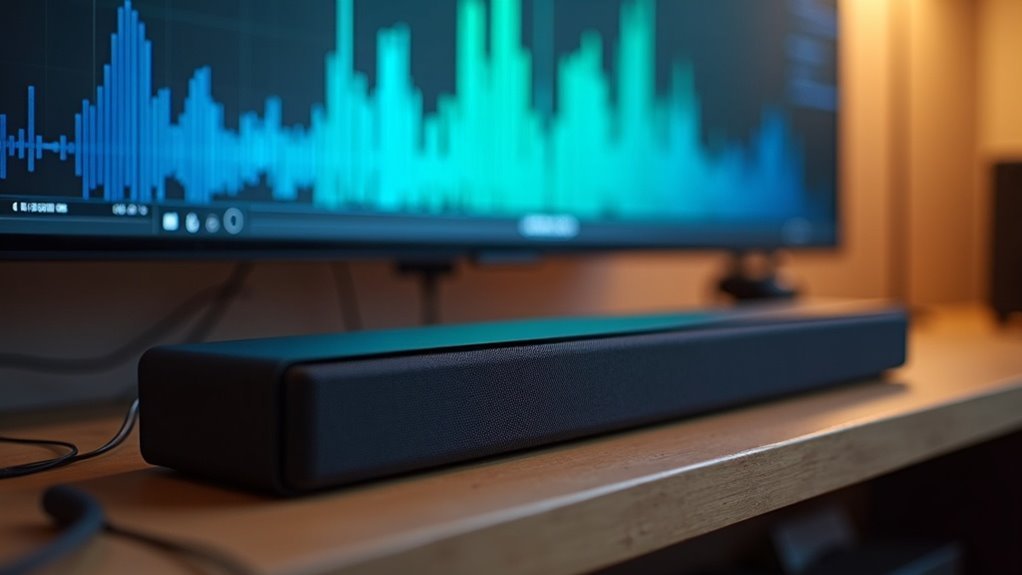
Soundbar sample rate conversion (SRC) is essential for optimizing audio playback on your soundbar. It adjusts audio sample rates to ensure compatibility, delivering high-quality sound. The process involves either up-sampling or down-sampling audio using specialized algorithms and low-pass filters to preserve audio integrity. This is particularly important because mismatched sample rates can lead to pitch distortion or a decline in sound quality. For the best listening experience, it’s crucial to align your soundbar’s sample rate with that of the source material. Explore more on how to maintain audio fidelity and elevate your soundbar experience.
Key Takeaways
- Sample rate conversion (SRC) in soundbars adjusts audio data’s sample rate for compatibility, ensuring optimal playback quality across various audio formats.
- Matching sample rates in soundbars prevents pitch distortion and maintains audio clarity, which is critical for high-resolution sound reproduction.
- Up-sampling and down-sampling techniques in soundbars utilize specialized interpolation and filtering methods to preserve sound integrity during conversion.
- Effective SRC in soundbars helps eliminate aliasing and distortion, significantly enhancing the overall listening experience.
- Choosing soundbars equipped with advanced resampling algorithms and high-resolution audio support ensures superior audio fidelity and compatibility.
Understanding Sample Rate Conversion
When selecting a soundbar, understanding sample rate conversion (SRC) can enhance your audio experience, especially if you want to ensure compatibility with various audio sources.
SRC involves adjusting the sample rate of audio data, which may be necessary when connecting different devices. This process includes up-sampling or down-sampling, and requires careful filtering to eliminate higher frequencies that could introduce artifacts.
SRC is crucial for ensuring seamless audio compatibility across devices, involving careful up-sampling or down-sampling with precise filtering techniques.
For instance, when a soundbar processes audio from a 44.1 kHz source to a 48 kHz output, specialized interpolation algorithms are used to maintain audio integrity. Applying low pass filters within the soundbar helps preserve sound quality, preventing pitch alterations or degradation.
It’s wise to choose a soundbar that effectively handles SRC within the same sample rate family to enhance compatibility and minimize potential audio issues.
Importance of Matching Sample Rates
Matching sample rates is essential for achieving ideal audio playback in soundbars. When the audio signal’s sample rate mismatches that of your soundbar, it can lead to pitch distortion and a degradation in audio quality. Maintaining consistent sample rates, such as 44.1kHz or 48kHz, ensures signal integrity and minimizes conversion artifacts. This is particularly crucial for preserving dynamic range and clarity, especially in high-resolution audio formats. Inconsistent sample rates can also result in synchronization issues, causing latency during playback.
| Sample Rate | Audio Source | Soundbar Compatibility |
|---|---|---|
| 44.1kHz | CD Audio | Yes |
| 48kHz | Video Sound | Yes |
| 96kHz | Hi-Res Audio | Requires Conversion |
| 192kHz | Studio Audio | Not Supported |
Techniques for Sample Rate Conversion
When you’re considering soundbars, understanding sample rate conversion techniques can greatly enhance audio performance.
Up-conversion in soundbars often utilizes interpolation methods, such as convolution with a Sinc function, to improve sound quality.
On the other hand, down-conversion requires precise filtering to avoid aliasing and ensure clarity.
Both processes demand careful attention to phase and group delay, ensuring that the audio experience is seamless and immersive for the listener.
Up-conversion Techniques
Although audio up-conversion might seem straightforward, it involves complex techniques designed to enhance the quality of soundbars by increasing the sample rate.
Key up-conversion techniques used in soundbar technology include:
- Interpolation methods for inserting additional samples to improve audio clarity
- Sinc function convolution to maintain signal integrity and prevent distortion
- Digital filters that ensure ideal audio quality for an immersive experience
- Specialized algorithms for non-integer conversions to optimize playback
- Staying within the same sample rate family for smoother transitions in sound reproduction
Down-conversion Strategies
Down-conversion strategies are essential for optimizing audio playback in soundbars, particularly when reducing sample rates from higher frequencies to lower ones.
A high-quality sample rate converter utilizes brick-wall filtering before decimation to eliminate frequencies above the Nyquist limit, preventing aliasing and ensuring a clear sound experience. Simply discarding samples can introduce undesirable artifacts and distortions; therefore, interpolation before filtering is necessary.
For non-integer down-sampling ratios, precise interpolation becomes even more critical, followed by effective filtering to guarantee audio fidelity. Maintaining the integrity of the audio signal during down-conversion is crucial; improper techniques can alter pitch and significantly degrade your overall listening experience on soundbars.
Challenges in Audio Fidelity
As soundbars increasingly serve as central components of home audio systems, the challenges in audio fidelity become more pronounced, particularly during sample rate conversion.
Key issues include:
- Non-integer sample rate conversions complicate processes.
- Down-sampling can lead to aliasing if samples are discarded improperly.
- Interpolation accuracy is important for preserving audio fidelity.
- Maintaining phase consistency is essential to avoid linear distortion.
- Advanced resampling techniques are necessary for minimizing distortion and latency.
These factors significantly influence the clarity and overall soundstage of your audio playback, making it crucial to understand how they affect your soundbar’s performance.
The Role of Filtering in Conversion
In soundbar design, pre-filtering is crucial to eliminate unwanted frequencies that could compromise audio quality.
You’ll often come across low-pass and phase-linear filters, which serve distinct purposes in maintaining sound integrity while avoiding distortion.
Understanding the impact of these filters on audio fidelity will enhance your appreciation of effective soundbar performance and sound quality.
Importance of Pre-filtering
While the process of sample rate conversion is essential for maintaining audio quality in soundbars, pre-filtering plays an indispensable role in preventing aliasing. By implementing a low-pass filter, soundbars can ensure that frequencies above half the target sample rate are attenuated.
Here are key aspects of pre-filtering in the context of soundbars:
- Mitigates distortion during down-sampling, ensuring clearer audio output.
- Enhances conversion efficiency by eliminating high-frequency content that can muddy sound quality.
- Guarantees a smooth transition between pass-band and stop-band for a seamless listening experience.
- Maintains phase linearity to prevent audible waveform distortions that could detract from the audio experience.
- Preserves audio integrity throughout the conversion process, ensuring that soundbars deliver high-fidelity sound.
With effective pre-filtering, soundbars safeguard the clarity and fidelity of audio signals, enhancing the overall listening experience.
Types of Filters Used
Understanding the types of filters used in sample rate conversion is essential for ensuring superior audio fidelity in soundbars. Low-pass filters play a significant role in filtering out frequencies above the Nyquist frequency, which helps prevent aliasing and preserves the audio quality.
When converting audio waveforms, phase-linear filters are preferred to avoid any linear distortions, ensuring accurate reproduction of sound. Ideal low-pass filters, often represented by the sinc function, assist in reconstructing waveforms from sampled data effectively.
FIR filters are commonly utilized in soundbars due to their stability and flexibility in designing impulse responses, making them ideal for various audio applications. Proper design of the shift band is vital for maintaining audio integrity during conversion, which is crucial for delivering an immersive listening experience.
Impact on Audio Quality
Effective filtering during sample rate conversion directly impacts audio quality in soundbars, as it plays a critical role in preventing aliasing and maintaining the integrity of the sound signal.
Key aspects of filtering for soundbars include:
- Attenuation of frequencies above the Nyquist limit to ensure clear audio reproduction
- Use of low-pass filters to maintain phase linearity, enhancing sound clarity
- Smooth shift in the filter’s transition band for a seamless audio experience
- Deployment of FIR filters for precise impulse responses, contributing to accurate sound staging
- Achieving a THD+N performance of -80 dBFs or better for optimal sound fidelity in soundbar systems
Implementing the SRC Generator Tool
To successfully implement the SRC generator tool, you’ll need to ensure that GNU Octave or Matlab® is installed on your Ubuntu system, which can be easily done using the command `sudo apt-get install octave octave-signal`.
To implement the SRC generator tool, first install GNU Octave or Matlab® on your Ubuntu system.
Next, create a .octaverc file in your home directory to load the signal package and disable the pager for smoother operation.
Launch the Octave shell from the tool directory with `cd tools/tune/srcoctave –gui`.
You can generate sample rate conversion coefficients with `src_generate([32e3 48e3],[44.1e3 48e3])`, allowing for various output samples like int16, int32, or float, which ensure ideal digital audio sample quality for soundbars.
Testing and Debugging SRC Components
After generating the sample rate conversion coefficients with the SRC generator tool, the next step involves rigorous testing and debugging of the soundbar components.
You’ll want to assess their performance against AES17 metrics, focusing on:
- Total harmonic distortion plus noise (THD+N)
- Frequency response
- Memory leak detection using Valgrind
- Code execution analysis with C debuggers or IDE tools
- Data visualization through Gnuplot
This process ensures that the soundbar delivers high-quality audio performance and meets industry standards.
Best Practices for Soundbar Audio Quality
Achieving ideal audio quality from your soundbar requires careful attention to several key factors.
First, set your soundbar to match the sample rate of your source material—typically 44.1 kHz for CDs and 48 kHz for DVDs—to prevent unnecessary sample rate conversion.
Set your soundbar to the source material’s sample rate—44.1 kHz for CDs and 48 kHz for DVDs—to avoid conversion issues.
Use digital connections like HDMI ARC or optical cables for minimal audio degradation.
Opt for a soundbar that supports high-resolution audio formats, such as 24-bit/96 kHz, to enhance playback quality.
Additionally, ensure your soundbar has advanced resampling algorithms for effective handling of non-integer sample rate conversions, and regularly update its firmware to maintain compatibility with the latest audio formats.
Following these best practices will help you maximize the audio experience from your soundbar.